










Claudio Ferrarini
A Fugue in Three Movements on a Theme of Air
I. EXPOSITION
(The subject appears.)
Summer, 1954.
Parma stretches like an unwritten staff beneath the sun. In a modest home, Claudio Ferrarini is born—already inscribed, though unknowingly, into a larger score.
At forty days old he crosses the border to Zurich. His parents emigrate; the child listens. Before he speaks, he learns the sound of distance.
Then destiny introduces its first dissonance: poliomyelitis. His left leg weakens. The body falters—but the breath grows stronger. As in every well-crafted fugue, the subject enters fragile, and therefore necessary.
At the Opernhaus Zürich he hears Wolfgang Amadeus Mozart. The Magic Flute does not entertain him—it initiates him. He understands that air can become song.
Yet it is with Johann Sebastian Bach that the subject finds its foundation.
Bach is not emotion—he is architecture.
Not narrative—foundation.
In the fugues and partitas, young Claudio discovers the hidden geometry of the world. If Mozart is dancing light, Bach is the column that sustains it.
The flute enters his life not as an instrument, but as a vertical axis between earth and sky.
The theme has been stated.
II. DEVELOPMENT
(The subject travels through tonalities.)
Returning to Parma during the years of progressive rock, Ferrarini crosses sonic territories like a restless knight: accordion, saxophone, private radio, electric bands. He even shares the stage with Le Orme, in an Italy vibrating between tradition and rebellion.
At his Conservatory entrance exam, he performs the “Bourrée” made famous by Jethro Tull—a modern transformation of Bach.
Past and present already converse as contrapuntal voices.
He studies with masters such as Gazzelloni, Nicolet, Klemm, Schulz, Stockhausen, and Cage.
From Cage he learns the living substance of silence.
From Gazzelloni, the fire of virtuosity.
From Bach, the invisible discipline beneath all expression.
At twenty-four he makes his solo debut at the Teatro Regio di Parma. The journey unfolds.
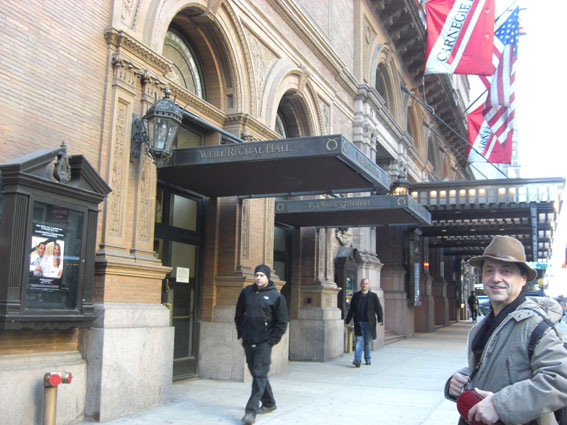
Soon the theme expands: Carnegie Hall, the Mozarteum, Berlin, Tokyo, Moscow. Each city a modulation; each stage a new tonal center.
His virtuosity is never ornament—it is structural necessity.
As in Bach, complexity serves revelation, not spectacle.
He confronts Paganini, transposing the violin’s impossible architecture into the realm of breath. Beneath the dazzling technical daring lies always the Bachian logic: every leap balanced, every storm anchored.
Founding Arte Sonora Records, he embraces digital dematerialization. The CD dissolves; music remains. The tablet replaces paper—not as rupture, but as evolution. Bach scrolls across a screen, yet vibrates with eighteenth-century fervor.
Meanwhile he teaches—nearly four decades at the Conservatory in Parma.
He does not transmit only technique; he transmits form.
Like voices in a fugue, his students become independent lines within a greater design.
The subject multiplies.
III. RECAPITULATION
(The theme returns, transformed.)
Today Claudio Ferrarini is not merely an interpreter.
He is synthesis.
Mozart gave him song.
Bach gave him structure.
Paganini gave him vertigo.
Cage gave him silence.
The fragile child of Zurich has become a builder of cathedrals of air.
More than 660 albums. Stages across the world. Gold and platinum instruments in his hands. Yet the true precious metal is the breath that passes through them.
Taoist, veganic, writer of historical novels, he continues to question time itself. For music is not only sound—it is testimony.
As in every perfect fugue, the final statement of the theme is not identical to the first.
It is deeper.
It has traversed tonalities, conflicts, and modulations.
And it returns—simple.
A man.
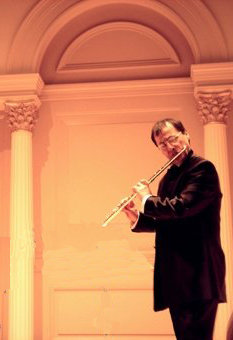
A flute.
A breath rising vertically like a prayer.
Bach would perhaps smile:
the subject remained faithful—
and became infinite.